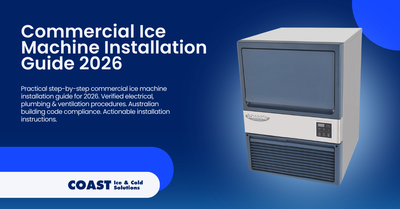
Commercial Ice Machine Installation Guide 2026: Practical Installation Manual
The Coast Team on 27th Jan 2026
Proper installation of commercial ice machines requires understanding Australian building codes, electrical standards, and plumbing requirements. This guide provides verified installation procedures based on Australian Standards AS/NZS 3000 (electrical) and AS/NZS 3500 (plumbing).
Important: Electrical and plumbing work must be performed by licensed tradespeople in Australia. This guide explains what licensed professionals need to know and what you should verify before installation.
Need professional installation?
Contact us for installation services. Coast Distributors provides installation services for Ice-O-Matic, Follett, Grant, Lassele models, and nrie
Table of Contents
- Pre-Installation Verification
- Site Requirements
- Electrical Installation (Licensed Electrician Required)
- Plumbing Installation (Licensed Plumber Required)
- Ventilation Requirements
- Installation Procedure
- Commissioning & Testing
- Australian Standards Compliance
- Common Installation Errors
- FAQ Section
- Conclusion
Pre-Installation Verification
Before installation begins, verify these requirements are met.
Site Assessment
Space Verification
Measure and verify:
- Machine dimensions match available space
- Clearances: 150mm sides, 200mm rear, 300mm top (for air-cooled units)
- Floor level within 3mm per metre
- Floor load capacity supports machine weight plus ice storage
- Access path for delivery and future service
Electrical Verification
Verify before installation:
- Voltage available: 240V single-phase (standard) or 415V three-phase (large systems)
- Circuit capacity: 10A minimum for small units, 15-20A for medium, 20A+ for large
- Dedicated circuit available (required for commercial units)
- RCD protection installed (mandatory per AS/NZS 3000:2018)
- Electrical panel location and accessibility
- Licensed electrician available for installation
Plumbing Verification
Verify before installation:
- Water supply: Cold potable water available
- Water pressure: 140-550kPa (test at installation point)
- Water quality: Potable water per FSANZ requirements
- Drain location: Floor drain or suitable drain point
- Drain capacity: 50mm minimum diameter, proper slope available
- Licensed plumber available for installation
Ventilation Verification
For air-cooled units, verify:
- Ambient temperature: Maximum 32°C for rated performance
- Airflow: Adequate ventilation for heat rejection
- Clearances: Sufficient space for condenser airflow
- Heat sources: No nearby heat-generating equipment
Required Documentation
Before installation, obtain:
- Manufacturer installation manual for your specific model (download from Coast Distributors' manuals page)
- Model number and serial number
- Electrical specifications from manufacturer
- Plumbing connection requirements from manufacturer
- Warranty information and installation requirements
Site Requirements
Space Requirements by Machine Type
Self-Contained/Undercounter Units
Verified Dimensions (from Coast Distributors product catalog):
- Ice-O-Matic UCG Series: Height 820-900mm, Width 380-610mm, Depth 500-650mm
- Lassele LUI Series: Varies by model (LUI-100A, LUI-150A, LUI-250A)
Clearance Requirements:
- Front-breathing units (Ice-O-Matic UCG): Can install flush against back and side walls
- Rear/side-venting units: 100-150mm clearance on vented sides
- Front: 150mm minimum for service access
Modular Ice Makers
Head Dimensions (approximate):
- Width: 600-900mm
- Depth: 600-800mm
- Height: 600-900mm
Storage Bin Dimensions:
- Ice-O-Matic B25: 110kg capacity
- Ice-O-Matic B40: 156kg capacity
- Height: 1,200-1,800mm (varies by bin)
Clearance Requirements:
- Front: 150mm minimum
- Sides: 150mm minimum
- Rear: 200mm minimum
- Top: 300mm minimum
Floor Requirements
Load-Bearing Capacity
- Self-contained units: 50-150kg (machine weight)
- Modular systems: 150-400kg (head + bin + ice storage)
- Verify floor supports total weight including maximum ice storage
Level Surface
- Machine must be level within 3mm per metre
- Use spirit level to verify
- Adjust machine feet or use shims if needed
- Check level in both directions (front-to-back and side-to-side)
Ambient Temperature
Air-Cooled Units
- Maximum ambient: 32°C for rated performance
- Performance decreases above 32°C
- Ideal ambient: 21-26°C
- Australian summer temperatures often exceed 32°C in many regions
Water-Cooled Units
- Consistent performance regardless of ambient temperature
- Higher water consumption: 3-4L per kg of ice
- Suitable for hot climates or enclosed spaces
- Requires continuous water supply and drainage
Electrical Installation (Licensed Electrician Required)
Critical: All electrical work must be performed by a licensed electrician per AS/NZS 3000:2018. This section explains what your electrician needs to know.
AS/NZS 3000:2018 Requirements
Mandatory Requirements
- Licensed electrician installation required
- RCD (Residual Current Device) protection mandatory on final sub-circuits
- Proper earthing and bonding
- Electrical testing and certification required
- Circuit protection appropriate for load
Electrical Specifications
Standard Australian Power
- Voltage: 240V single-phase, 50Hz (most commercial units)
- Large systems: 415V three-phase, 50Hz (some Grant and large modular systems)
Circuit Requirements by Machine Size
Based on verified specifications:
Small Units (20-50kg/day):
- Ice-O-Matic UCG Series: 240V, 10A
- Lassele LUI Series: 240V, 10A
- Circuit: 10A dedicated circuit minimum
Medium Units (50-130kg/day):
- Ice-O-Matic ICEU225: 240V, 10-15A
- Circuit: 15A dedicated circuit
Modular Systems (130kg+/day):
- Ice-O-Matic CIM Series: 240V, 6.5-12A (per manufacturer specifications)
- Follett Maestro Plus: 240V, 8.5-15A (per manufacturer specifications)
- Circuit: 15-20A dedicated circuit
Large Systems:
- Grant Sub-Zero Systems: 240V single-phase or 415V three-phase, 15-35A
- Circuit: 20A+ or three-phase as required
Important: Always verify specific amperage requirements from your model's installation manual. Download from Coast Distributors' manuals page.
Electrical Installation Procedure
Step 1: Power Isolation
- Turn off circuit breaker
- Lock out/tag out circuit per safety procedures
- Test for voltage with multimeter (verify power is off)
- Verify no voltage at installation point
Step 2: Cable Installation
- Route cable from electrical panel to machine location
- Use appropriate cable protection (conduit or appropriate method)
- Leave service loop for future access
- Follow AS/NZS 3000:2018 cable installation requirements
Step 3: Circuit Breaker Installation
- Install dedicated circuit breaker in electrical panel
- Size circuit breaker per manufacturer specifications
- Install RCD protection (mandatory per AS/NZS 3000:2018)
- Label circuit clearly
Step 4: Machine Connection
- Follow manufacturer wiring diagram (from installation manual)
- Connect line, neutral, and earth
- Verify tight connections
- Install cable strain relief
- Secure all connections
Step 5: Testing and Certification
- Verify voltage at machine terminals (240V ±10%)
- Test RCD operation
- Check earth continuity
- Verify proper polarity
- Complete electrical testing per AS/NZS 3000:2018
- Obtain electrical certificate of compliance
Important: Electrical work must be tested and certified by licensed electrician before operation. Coast Distributors installation services include certified electrical connections.
Plumbing Installation (Licensed Plumber Required)
Critical: Plumbing work must be performed by a licensed plumber in most Australian states per AS/NZS 3500. This section explains what your plumber needs to know.
AS/NZS 3500 Requirements
Mandatory Requirements
- Licensed plumber installation required (most states)
- Backflow prevention required
- Air gap required (prevents backflow contamination)
- Potable water supply required (FSANZ requirement)
- Proper drainage with adequate slope
Water Supply Requirements
Water Pressure
- Minimum: 140kPa (20 psi)
- Maximum: 550kPa (80 psi)
- Optimal: 200-400kPa (30-60 psi)
Water Pressure Testing
- Test pressure at installation point using pressure gauge
- If pressure exceeds 550kPa: Install pressure reducer
- If pressure below 140kPa: Install pressure booster (consult plumber)
Water Quality
- Potable water required per FSANZ (ice is classified as food)
- Water filtration strongly recommended
- Hard water areas (Adelaide, Perth, regional Australia) require enhanced filtration
Water Filtration
Coast Distributors recommends:
- CD20B high-capacity filter - Standard commercial applications
- CD40B filter - High-volume systems
- CD500B filter - Maximum capacity systems
Water Supply Installation
Pipe Size
- Small units: ½" (12mm) or ¼" (check model specifications)
- Medium to large units: ¾" (19mm) typically
- Verify specific requirements in installation manual
Pipe Material
- Copper preferred (durable, food-safe, AS/NZS 4020 compliant)
- PEX acceptable (flexible, easy installation)
- Avoid PVC for supply lines (not rated for pressure)
Installation Steps
- Install shut-off valve in accessible location
- Run supply line to machine location
- Install water filter before machine connection
- Connect to machine inlet using appropriate fittings
- Test for leaks: Pressurize system and check all connections
- Verify water flow and pressure
Drainage Installation
Drain Line Requirements
- Minimum diameter: 50mm (2")
- Larger for high-capacity units (check specifications)
- Proper slope: 1:40 minimum (25mm fall per metre)
- Gravity drain preferred (no pump required)
Drain Installation Steps
- Locate drain point (floor drain preferred)
- Run drain line with proper slope (1:40 minimum)
- Install air gap: 25mm minimum above drain (per AS/NZS 3500)
- Secure drain line (prevent sagging)
- Test drainage: Pour water and verify flow
Air Gap Requirements
- 25mm minimum air gap required
- Prevents backflow contamination
- AS/NZS 3500 compliance requirement
- Install at appropriate height above drain
Drain Pump Systems
- Required when machine above drain level
- Pump must handle continuous operation
- Install check valve to prevent backflow
- Regular maintenance required
Important: Plumbing work must comply with AS/NZS 3500 and be performed by licensed plumber. Coast Distributors installation services include certified plumbing connections.
Ventilation Requirements
Air-Cooled Unit Ventilation
Clearance Requirements
- Front: 150mm minimum (service access)
- Sides: 150mm minimum (air circulation)
- Rear: 200mm minimum (condenser airflow)
- Top: 300mm minimum (heat rejection)
Airflow Requirements
- Adequate airflow through condenser coils
- No obstructions blocking air intake or exhaust
- Avoid recirculating hot air
- Ensure fresh air supply
Ambient Temperature
- Maximum: 32°C for rated performance
- Performance decreases above 32°C
- Ideal: 21-26°C
Ventilation Solutions
Natural Ventilation
- Open area with good airflow
- Windows or vents nearby
- Avoid enclosed spaces
- Ensure air circulates freely
Mechanical Ventilation
- Exhaust fans for enclosed spaces
- Supply fans for fresh air
- Proper sizing for heat rejection
- Regular maintenance required
Installation Procedure
Step 1: Unpacking and Inspection
Unpacking
- Remove packaging carefully
- Inspect for shipping damage
- Verify all components included
- Check for missing parts
Inspection Checklist
- Machine undamaged
- All components present
- Documentation included (installation manual, warranty card)
- Model number matches order
- Serial number recorded
Report any damage immediately to Coast Distributors. Do not proceed with damaged equipment. Contact us for replacement parts or warranty claims. Parts available from Coast Distributors warehouses in Sydney, Melbourne, and Perth.
Step 2: Positioning
Location
- Place in planned location
- Ensure adequate clearances (150mm sides, 200mm rear, 300mm top for air-cooled)
- Verify level surface
- Check access for service
Leveling
- Use spirit level to check level
- Adjust feet/shim as needed
- Level within 3mm per metre
- Verify in both directions (front-to-back and side-to-side)
Important: Unlevel installation causes poor ice production and equipment damage.
Step 3: Electrical Connection
Licensed electrician required per AS/NZS 3000:2018
Your electrician will:
- Verify power is off (test with multimeter)
- Check voltage matches requirements (240V single-phase standard)
- Verify circuit capacity
- Confirm RCD protection
- Follow manufacturer wiring diagram (from installation manual)
- Connect line, neutral, and earth
- Secure connections properly
- Install cable strain relief
- Test connections
- Verify voltage at terminals
- Test RCD operation
- Check earth continuity
- Verify proper polarity
- Complete electrical certification
Step 4: Water Supply Connection
Licensed plumber required per AS/NZS 3500
Your plumber will:
- Install shut-off valve (accessible location)
- Test water pressure (140-550kPa required)
- Verify water quality (potable water per FSANZ)
- Install water filter (strongly recommended)
- Connect supply line to machine
- Use appropriate fittings
- Secure connections
- Test for leaks
- Turn on water supply
- Check for leaks
- Verify water flow
- Test water pressure
Step 5: Drain Connection
Licensed plumber required per AS/NZS 3500
Your plumber will:
- Locate drain point (floor drain preferred)
- Verify proper slope (1:40 minimum)
- Check drain capacity (50mm minimum)
- Install air gap (25mm minimum per AS/NZS 3500)
- Connect drain line
- Secure properly
- Test drainage (pour water, verify flow)
- Check for leaks
- Verify air gap
Step 6: Final Checks
Pre-Startup Checklist
- Machine level (within 3mm per metre)
- Electrical connected and tested (by licensed electrician)
- Water supply connected and tested
- Water filter installed
- Drain connected and tested
- Clearances adequate
- Ventilation adequate
- All connections secure
- Documentation reviewed (installation manual, warranty information)
- Serial number recorded for warranty registration
Commissioning & Testing
Initial Startup
Step 1: Power On
- Turn on circuit breaker
- Verify machine powers on
- Check for error codes (refer to model-specific error code guide in installation manual)
- Listen for unusual sounds
Step 2: Water Flow Check
- Verify water flows to machine
- Check for leaks
- Monitor water pressure
- Verify filter operation
Step 3: First Ice Production Cycle
- Allow machine to complete first cycle (typically 15-30 minutes depending on model)
- Monitor ice production
- Check ice quality
- Verify storage operation
Step 4: Performance Verification
- Measure ice production (compare to model specifications)
- Check ice quality (clarity, size consistency)
- Verify storage capacity
- Monitor temperature
Performance Testing
Ice Production Test
- Run machine for 24 hours
- Measure total ice production
- Compare to specifications
- Account for ambient conditions
Ice Quality Check
- Check ice clarity
- Verify ice size consistency
- Test ice hardness
- Check for odors or tastes
Storage Test
- Fill storage bin
- Monitor ice level
- Check bin operation
- Verify dispenser (if applicable)
Troubleshooting Initial Issues
No Ice Production
- Check water supply
- Verify electrical connection
- Check for error codes
- Review troubleshooting guide
Low Ice Production
- Check ambient temperature
- Verify water temperature
- Check water pressure
- Review ventilation
Poor Ice Quality
- Check water quality
- Verify filter operation
- Check machine cleanliness
- Review water treatment
Documentation
Record Keeping
- Installation date
- Serial number
- Model number
- Installation location
- Service technician contact
- Warranty information
Maintenance Schedule
- Set up cleaning schedule
- Schedule filter replacements
- Plan regular service
- Document maintenance
Australian Standards Compliance
AS/NZS 3000:2018 Electrical Installations
Requirements
- Licensed electrician installation required
- RCD protection mandatory
- Proper earthing essential
- Circuit protection appropriate
- Electrical testing and certification required
Compliance
- Electrical work must be certified
- Tested and tagged
- Documentation provided
- Regular inspection recommended
Coast Distributors Installation Services: Coast Distributors installations are performed by licensed electricians. Certification documentation is provided as part of installation services. Contact us for installation services.
AS/NZS 3500 Plumbing and Drainage
Requirements
- Licensed plumber installation required (most states)
- Backflow prevention required
- Proper air gaps (25mm minimum)
- Potable water supply
- Proper drainage
Compliance
- Plumbing work certified
- Water quality verified
- Drainage tested
- Documentation provided
Coast Distributors Installation Services: Coast Distributors installations are performed by licensed plumbers. AS/NZS 3500 compliance documentation is provided as part of installation services. Contact us for installation services.
FSANZ Food Safety Standards
Requirements
- Ice classified as food
- Potable water required
- Sanitization procedures
- Regular cleaning required
- Food safety compliance
Compliance
- Water quality verified
- Cleaning procedures documented
- Sanitization schedule maintained
- Health department compliance
Coast Distributors Support: Coast Distributors can provide FSANZ compliance guidance and documentation as part of installation services. Contact us for food safety compliance support.
Common Installation Errors
Error 1: Insufficient Clearances
Problem:
- Reduced airflow
- Overheating
- Reduced performance
- Equipment damage
Solution:
- Follow clearance requirements: 150mm sides, 200mm rear, 300mm top
- Verify clearances before installation
- Don't compromise on clearances
Error 2: Incorrect Electrical Connection
Problem:
- Equipment damage
- Fire hazard
- Voided warranty
- Safety risk
Solution:
- Use licensed electrician
- Verify voltage and amperage
- Install dedicated circuit
- Test all connections
- Obtain electrical certification
Error 3: Poor Water Supply
Problem:
- Reduced ice production
- Scale buildup
- Equipment damage
- Poor ice quality
Solution:
- Test water pressure (140-550kPa)
- Install water filter
- Verify water quality
- Check water temperature
Error 4: Inadequate Drainage
Problem:
- Water overflow
- Floor damage
- Health code violations
- Equipment malfunction
Solution:
- Proper drain slope (1:40 minimum)
- Adequate drain size (50mm minimum)
- Install air gap (25mm minimum)
- Test drainage thoroughly
Error 5: Unlevel Installation
Problem:
- Poor ice production
- Equipment damage
- Ice quality issues
- Premature failure
Solution:
- Level machine properly
- Use spirit level
- Adjust feet/shim
- Verify in both directions
Error 6: Insufficient Ventilation
Problem:
- Overheating
- Reduced performance
- Equipment damage
- Increased energy consumption
Solution:
- Ensure adequate clearances
- Provide fresh air supply
- Avoid recirculating hot air
- Consider water-cooled for hot environments
Error 7: Skipping Water Filtration
Problem:
- Scale buildup
- Reduced efficiency
- Equipment damage
- Poor ice quality
Solution:
- Install appropriate water filter
- Replace filters regularly
- Monitor water quality
- Follow manufacturer recommendations
FAQ Section
What are the electrical requirements for commercial ice machine installation in Australia?
Commercial ice machines in Australia require 240V single-phase, 50Hz power. Small undercounter units (20-50kg/day) need 10A circuits. Medium units (50-130kg/day) require 15A circuits. Large modular systems (500kg+/day) need 20A+ or three-phase power. All installations must comply with AS/NZS 3000:2018 and include RCD protection. A licensed electrician must perform all electrical work.
Do I need a licensed plumber to install a commercial ice machine in Australia?
In most Australian states, plumbing work requires a licensed plumber. This includes connecting water supply lines, installing drains, and ensuring compliance with AS/NZS 3500. Even if you're doing other installation work yourself, water and drain connections should be performed by a licensed plumber to ensure compliance and maintain warranties.
What water pressure is required for commercial ice machines?
Commercial ice machines require water pressure between 140kPa (20 psi) minimum and 550kPa (80 psi) maximum. Optimal pressure is 200-400kPa (30-60 psi). If your water pressure exceeds 550kPa, install a pressure reducer. If pressure is below 140kPa, you need a pressure booster system. Consult a plumber.
How much clearance does an air-cooled ice machine need?
Air-cooled ice machines require minimum clearances: 150mm on sides, 200mm at rear, and 300mm on top. These clearances ensure adequate airflow for heat rejection. Insufficient clearance causes overheating, reduced performance, and equipment damage.
Can I install a commercial ice machine myself?
Small self-contained units suit DIY installation if you have experience. Electrical and plumbing work requires licensed tradespeople in Australia. Large modular systems require professional installation. DIY installation risks voiding warranties, building code violations, and equipment damage. Professional installation ensures compliance and maintains warranties.
What is the difference between air-cooled and water-cooled ice machines for installation?
Air-cooled units use ambient air for cooling and require adequate ventilation and clearances. They're simpler to install but performance degrades in hot environments (above 32°C). Water-cooled units use water for cooling, providing consistent performance regardless of ambient temperature but requiring more water (3-4L per kg of ice) and higher operating costs. Water-cooled units are better for hot climates or enclosed spaces.
Do commercial ice machines need water filters?
Water filtration is strongly recommended and often required for warranty coverage. Filters prevent scale buildup, improve ice quality, and extend equipment life. Hard water areas (common in Adelaide, Perth, and regional Australia) require enhanced filtration. Recommended filters include the CD20B high-capacity filter for standard applications and the CD40B filter for high-volume systems.
What drainage requirements are needed for commercial ice machines?
Commercial ice machines require 50mm minimum drain lines with proper slope (1:40 minimum). Gravity drainage is preferred over pump systems. An air gap of 25mm minimum is required per AS/NZS 3500 to prevent backflow. The drain must handle continuous operation and occasional peak flows during cleaning cycles.
How do I know if my location is suitable for an ice machine installation?
A suitable location has: adequate space with proper clearances, level floor surface, ambient temperature 10-32°C (for air-cooled), good ventilation, access to cold water supply and drainage, dedicated electrical circuit, and is away from heat sources, direct sunlight, and high-dust areas. Complete a site assessment before installation.
What happens if I install an ice machine incorrectly?
Incorrect installation causes reduced ice production, equipment damage, voided warranties, building code violations, safety hazards, increased operating costs, and premature equipment failure. Professional installation prevents these issues and ensures optimal performance.
Do I need building permits for commercial ice machine installation?
Building permit requirements vary by location and installation complexity. Simple installations do not require permits. Electrical and plumbing work requires certification. Check with your local council and consult licensed tradespeople. Complex installations or modifications to building services require permits.
How long does commercial ice machine installation take?
Installation time varies. Small self-contained units take 2-4 hours. Medium units take 4-6 hours. Large modular systems take 6-8 hours or more. Time includes site preparation, electrical and plumbing work, machine positioning, testing, and commissioning. Professional installers provide accurate time estimates based on your specific situation.
What maintenance is required after installation?
Regular maintenance includes: daily visual inspections, weekly cleaning of accessible areas, monthly deep cleaning and sanitization, quarterly filter replacements, and annual professional service. See our maintenance and cleaning guide for detailed schedules and procedures.
Conclusion
Proper installation of your commercial ice machine is fundamental to its performance, longevity, and compliance with Australian building codes and food safety regulations. Following verified installation procedures ensures your installation meets all requirements and provides years of reliable service.
Key installation principles include: thorough pre-installation verification, adequate space and ventilation, proper electrical and plumbing connections by licensed tradespeople, compliance with Australian standards (AS/NZS 3000:2018, AS/NZS 3500, FSANZ), professional installation for complex systems, and regular maintenance after installation.
Electrical and plumbing work requires licensed tradespeople in Australia. Professional installation helps maintain warranties (check specific brand requirements) and ensures compliance. For complex installations or if you are unsure, consult qualified professionals.
Ready to install your commercial ice machine?
Contact us for professional installation services. Coast Distributors provides installation services for Ice-O-Matic, Follett, Grant, and Lassele models. Parts and service available from Coast Distributors warehouses in Sydney, Melbourne, and Perth.
Contact us to confirm service availability in your area.
Related Resources
Guides
- Best Commercial Ice Machines 2026 - Complete buying guide with product comparisons
- Best Undercounter Ice Machines 2026 - Undercounter installation considerations
- Best Modular Ice Machines 2026 - Modular system installation requirements
- Commercial Ice Machine Maintenance & Cleaning Guide 2026 - Post-installation maintenance
- Commercial Ice Machine Troubleshooting Guide 2026 - Common installation-related issues
Product Categories
- Modular Ice Makers - High-capacity systems
- Self-Contained Ice Makers - Compact units
- Storage Bins - Modular system storage
- Water Filters - Installation-essential filters