Industrial Flake Ice Machines for Food Processing: Grant FF-AR Series (400kg to 5000kg Daily Production)
The Coast Team on 11th Dec 2025
Food processing facilities across Australia face a common challenge: maintaining precise temperature control during production while meeting strict food safety requirements. Flake ice has become the preferred solution for seafood processors, meat packing plants, poultry operations, and fresh produce handlers. The Grant FF-AR Series delivers sub-zero flake ice at production capacities ranging from 400kg to 5,000kg per day, addressing the demands of small processing operations through to large-scale industrial manufacturing.
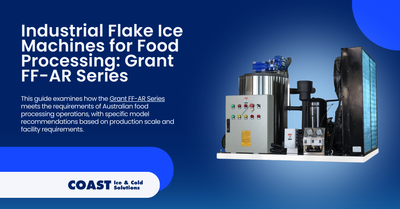
This guide examines how the Grant FF-AR Series meets the requirements of Australian food processing operations, with specific model recommendations based on production scale and facility requirements.
Why Food Processing Facilities Choose Flake Ice Over Other Ice Types
Flake ice differs from cube or crescent ice in ways that matter for food manufacturing. The ice emerges from Grant machines at -9°C, colder than standard flake ice produced by conventional systems. This temperature allows direct contact with food products without causing freezer burn while providing rapid cooling during critical production stages.
The physical structure of flake ice creates another advantage. Thin, irregular flakes conform to product surfaces without creating pressure points. When you pack fresh fish or shellfish in flake ice, the ice moulds around the product rather than sitting on top of it. This maximises the contact surface area between ice and product, accelerating heat transfer and maintaining consistent temperatures throughout storage and transport.
For meat processing applications, flake ice serves multiple functions. Production teams use it to maintain safe temperatures during grinding and mixing operations. The ice absorbs heat generated by mechanical processing while adding moisture that improves product texture. Poultry processors rely on flake ice for carcass chilling after slaughter, where rapid temperature reduction is mandated by food safety regulations.
Supermarket applications extend beyond the obvious seafood display cases. Produce departments use flake ice to maintain humidity around leafy greens and other temperature-sensitive vegetables. The melting ice creates a micro-climate that extends shelf life without direct water contact that could promote bacterial growth.
Grant FF-AR Series: Technical Specifications and Production Capacities
The Grant FF-AR Series includes eight models spanning production capacities from 400kg to 5,000kg over 24 hours. Each machine produces sub-zero flake ice using a static vertical evaporator system that requires minimal maintenance throughout its operational life.
Entry-Level Models for Smaller Processing Operations
The FF0.4AR produces up to 400kg of ice daily. With dimensions of 1090mm wide by 700mm deep by 745mm high, this model fits into smaller production areas without requiring significant floor space allocation. The FF0.4AR runs on single-phase 20-amp power, eliminating the need for three-phase electrical infrastructure upgrades that smaller facilities often lack.
For operations requiring slightly more capacity, the FF0.6AR delivers 600kg daily output. Both the FF0.4AR and FF0.6AR feature self-contained air-cooled refrigeration, meaning they operate as standalone units without external condensers or complex installation requirements.
Mid-Range Models for Commercial Food Processing
The FF1AR marks the transition to three-phase power requirements and higher production volumes. The FF1AR produces up to 1,000kg of ice per 24 hours within a footprint of 1320mm wide by 1050mm deep by 890mm high. Stainless steel covers protect the evaporator and compressor components, an important consideration for facilities where regular washdown procedures are standard practice.
Stepping up through the range, the FF1.5AR produces 1,500kg daily, the FF2AR produces 2,000kg, and the FF2.5AR produces 2,500kg. The FF1.5AR, FF2AR, and FF2.5AR each maintain self-contained air-cooled refrigeration, keeping installation requirements straightforward.
High-Capacity Models for Industrial Food Manufacturing
The FF3AR delivers 3,000kg of sub-zero flake ice daily. At 1600mm wide by 1050mm deep by 1290mm high, the FF3AR serves medium to large food processing plants with continuous ice requirements. The FF3AR retains self-contained air cooling, avoiding the installation complexity of split systems while still delivering industrial-scale output.
For facilities requiring maximum production capacity, the FF5AS produces up to 5,000kg of ice per 24 hours. The FF5AS uses a remote air-cooled condenser, separating the heat rejection component from the evaporator unit. The FF5AS evaporator and compressor measure 2100mm wide by 1800mm deep by 1250mm high, while the remote condenser measures 2008mm wide by 908mm deep by 1422mm high. This configuration allows facilities to locate heat-generating components outside production areas, reducing ambient temperatures and improving refrigeration efficiency.
For operations requiring more than 5,000kg daily, the FF10AS doubles output capacity to 10,000kg per 24 hours, using the same remote condenser architecture as the FF5AS.
Construction Quality and Food Safety Compliance
Every Grant FF-AR model uses 304 stainless steel for the evaporator, base, and control panel. This grade of stainless steel resists corrosion from the chlorides present in ice melt water and withstands the caustic cleaning agents used in food processing sanitation programs. The material selection matters for facilities operating under HACCP protocols, where equipment surfaces must support effective cleaning and sanitisation procedures.
The static vertical evaporator design eliminates the rotating drum mechanisms found in some competing flake ice systems. Without moving parts in contact with ice formation surfaces, there are fewer components requiring lubrication, fewer wear items requiring replacement, and fewer opportunities for mechanical failure during production operations. Grant backs this design confidence with a 5-year warranty on evaporators, compared to the 3-year warranty covering complete systems.
All Grant FF-AR Series models use R404A refrigerant, a common choice for commercial refrigeration applications. While regulatory frameworks are shifting toward lower global warming potential refrigerants, R404A remains widely available for service and maintenance, and qualified refrigeration technicians have extensive experience with this refrigerant type.
Calculating Ice Production Requirements for Food Processing
Selecting the right model requires understanding your facility's actual ice consumption patterns. Peak demand periods drive capacity requirements more than average daily usage.
Seafood Processing Calculations
Seafood operations typically require 1kg to 2kg of ice per kilogram of product for display and short-term storage. Longer transport chains demand higher ice-to-product ratios. A facility processing 500kg of fish daily for local distribution might consume 750kg of ice, making the FF1AR appropriate. The same facility supplying products for interstate transport might require 1,500kg of ice daily, pushing requirements toward the FF2AR.
Processing operations with receiving, holding, and packing stations running simultaneously need to account for concurrent ice demand across multiple production points. A 1,000kg daily production capacity from the FF1AR might prove insufficient if 800kg of that ice is needed during a four-hour morning processing window.
Meat and Poultry Processing Calculations
Meat grinding and mixing operations consume ice at rates determined by batch sizes and processing temperatures. Commercial-scale grinding typically requires 10% to 15% ice addition by weight to control temperature during mechanical processing. A facility running 2,000kg of product through grinders daily would consume 200kg to 300kg of ice in grinding alone, before accounting for chilling and storage requirements. The FF0.6AR would handle grinding requirements, while facilities with additional chilling needs should consider the FF1AR or FF1.5AR.
Poultry processing follows regulatory requirements for carcass chilling. Birds must reach internal temperatures below 4°C within specified timeframes after slaughter. The ice volume required depends on line speeds, bird weights, and chilling system configurations. High-volume poultry processors operating continuous chilling systems should consult with process engineers to determine ice consumption rates specific to their production parameters.
Supermarket and Fresh Produce Applications
Retail operations have different consumption patterns than processing facilities. Ice requirements peak during store opening hours and fresh product delivery periods. A supermarket seafood department might consume 50kg to 100kg of ice daily, well within the capacity of the FF0.4AR. Larger stores with extensive fresh departments and high-volume seafood sections might require 200kg to 400kg daily, still within FF0.4AR capacity or stepping up to the FF0.6AR.
Multiple retail locations present consolidation opportunities. A central commissary producing flake ice for distribution to several stores can achieve better equipment utilisation than individual store-based machines, though this approach requires ice transport and storage infrastructure.
Ice Storage: Pairing Machines with Appropriate Bins
Production capacity means little without adequate storage to accumulate ice during off-peak hours for use during production peaks. Grant manufactures upright storage bins designed specifically for their flake ice machines.
The CX400R stores up to 400kg of ice and pairs with the FF0.4AR and FF0.6AR models. The CX400R roto-moulded poly-liner construction insulates stored ice while providing a sanitary surface that cleans easily.
For mid-range production, the CX800R holds 800kg of ice, appropriate for the FF1AR through FF1.5AR models. The CX1200R stores 1,200kg and is designed to pair with FF2AR and FF2.5AR machines. The CX1200R measures 1608mm wide by 1058mm deep by 1460mm high, with an overall depth of 1393mm including the discharge snout.
Each bin including the CX400R, CX800R, and CX1200R features a first-in-first-out design that ensures older ice moves toward the discharge point rather than accumulating at the bottom. This matters for food safety, preventing ice from sitting in storage for extended periods where it might absorb odours or develop quality issues.
Reinforced stainless steel tops allow the bins to support ice makers mounted directly above, creating integrated production and storage systems with minimal floor space requirements. These reinforced tops are compatible with Ice-O-Matic and Follett ice makers as well as Grant units, providing flexibility for facilities using equipment from multiple manufacturers.
Water Quality and Filtration Requirements
Ice quality depends directly on incoming water quality. Dissolved minerals, chlorine, and particulates present in source water transfer into finished ice. In food processing applications, where ice contacts products directly, water treatment becomes a food safety consideration rather than simply an equipment protection measure.
Grant recommends the CD40B water filter for models from the FF0.4AR through the FF3AR. The CD40B addresses scale-forming minerals and particulates without requiring complex multi-stage treatment systems. The carbon element in the CD40B reduces chlorine that can affect ice taste and odour.
Larger models like the FF5AS and FF10AS require the CDPSJ200 filter system to handle higher water flow volumes. The CDPSJ200 accommodates the greater daily water consumption of high-capacity machines while maintaining the same mineral reduction and particulate removal performance.
Water hardness in many Australian regions poses particular challenges for ice equipment. Scale accumulation on evaporator surfaces reduces ice production efficiency and eventually damages components. Regular filter replacement according to manufacturer schedules protects equipment investment and maintains production capacity over time.
Coast Distributors offers a complete range of water filters suitable for various water conditions and ice machine capacities.
Installation Considerations for Food Processing Environments
Electrical Requirements
The FF0.4AR and FF0.6AR operate on single-phase 20-amp circuits, making them suitable for facilities without three-phase power infrastructure. All larger models including the FF1AR, FF1.5AR, FF2AR, FF2.5AR, FF3AR, FF5AS, and FF10AS require three-phase power connections. Facilities installing the FF1AR or larger units should verify three-phase availability and consult qualified electricians regarding circuit capacity and connection requirements.
Ventilation and Heat Rejection
Self-contained air-cooled models including the FF0.4AR through FF3AR reject heat from their internal condensers directly into the surrounding space. These units require adequate clearance around condenser air intakes and exhausts, typically 300mm to 500mm depending on the model. Enclosed spaces without mechanical ventilation will experience temperature increases that reduce ice production efficiency and increase energy consumption.
The FF5AS and FF10AS models address this issue through remote condenser configurations. Locating the condenser outside the production area or in a dedicated mechanical room eliminates heat rejection concerns within processing spaces. This configuration requires refrigerant piping between the evaporator unit and remote condenser, adding installation complexity but improving overall system performance in hot climates or poorly ventilated facilities.
Drainage
All Grant FF-AR Series models produce melt water requiring drainage. Floor drains positioned near ice machines should connect to appropriate waste systems. In food processing facilities operating under regulatory oversight, drainage configurations may require specific approvals. Air gaps or backflow prevention devices might be mandated depending on local health authority requirements.
Floor Loading
Larger models, particularly when fully loaded with ice in mounted storage bins, exert significant floor loads. The FF5AS with a full ice storage bin can impose concentrated loads that exceed the capacity of standard commercial flooring. Structural engineers should review floor specifications before installing high-capacity equipment, particularly on upper floors or in facilities with suspended concrete slab construction.
Complementary Equipment for Complete Cold Chain Systems
Blast Chillers for Rapid Product Cooling
Flake ice maintains cold temperatures after products reach target temperatures, but initial rapid chilling often requires dedicated blast chilling equipment. Friulinox blast chillers complement ice systems in food processing operations where products must pass through the temperature danger zone quickly.
The Ready Regular series handles batch chilling requirements for prepared foods, while the Ready Super series delivers faster cooling for applications requiring tighter time-temperature control. The Submarine Multi-Function Units provide versatility for operations requiring both blast chilling and other temperature control functions.
Air and Surface Sanitation
Food processing environments benefit from continuous air treatment to reduce airborne contamination. HyGenikx air and surface sanitisers operate continuously to reduce bacterial loads in production spaces. These units complement ice machine sanitation programs without requiring chemical treatments that might leave residues on food contact surfaces.
Ice Transport and Handling
Moving ice from production to point of use requires appropriate handling equipment. The Follett Smart Cart 125 transports ice through production facilities without the contamination risks associated with open containers. For smaller operations, the Smart Cart 75 provides a compact option, while the Smart Cart 240 handles larger volume transport needs. These mobile bins maintain ice quality while allowing efficient distribution across multiple production stations.
For facilities bagging ice for sale or distribution, the Follett Ice Pro Bagger automates the filling and sealing process. The Ice Pro Bagger reduces labour requirements while ensuring consistent bag weights and secure closures.
Service and Support Considerations
Equipment reliability matters in food processing where production schedules run tightly and downtime costs mount quickly. Grant equipment carries a 3-year parts and labour warranty on complete systems, with the 5-year evaporator warranty providing additional protection on the core ice-making component.
Coast Distributors maintains service operations from their head office at 12 Brady Street, Berkeley NSW 2506 and their Melbourne location at Unit 25/44 Mahoneys Road, Thomastown VIC 3074. The freecall number 1800 688 590 connects callers with the sales and service team for enquiries ranging from equipment selection through spare parts and technical support.
The service request system handles warranty claims and scheduled maintenance bookings. The spare parts request process expedites parts supply for facilities with qualified technicians handling their own repairs. Technical documentation, including specification sheets and service manuals, is available through the Coast Distributors website. The warranty registration portal allows customers to register new equipment purchases.
Selecting the Right Model for Your Operation
For Small-Scale Processing or Retail (Under 600kg Daily)
The FF0.4AR suits single retail seafood departments, small fish markets, or processing operations with limited ice requirements. Single-phase power compatibility and compact dimensions make the FF0.4AR accessible for facilities without specialised infrastructure. Pair with the CX400R storage bin for operations requiring ice accumulation between production and usage periods.
For Medium Processing Operations (600kg to 1,500kg Daily)
The FF1AR addresses most medium-scale food processing applications. With 1,000kg daily production capacity, the FF1AR handles seasonal peaks typical in seafood processing while maintaining reasonable equipment costs and installation complexity. The CX800R provides appropriate storage capacity for most medium-scale operations using the FF1AR.
For Commercial Food Manufacturing (1,500kg to 3,000kg Daily)
The FF2AR, FF2.5AR, and FF3AR address commercial food manufacturing requirements. The self-contained configurations simplify installation while delivering production volumes suited to multi-shift processing operations. Storage requirements at these production levels typically call for the CX1200R or multiple smaller bins positioned at different production points.
For Industrial-Scale Production (3,000kg+ Daily)
The FF5AS and FF10AS serve large-scale food manufacturing with continuous ice requirements. Remote condenser configurations on the FF5AS and FF10AS handle heat rejection outside production areas, maintaining working conditions while maximising refrigeration efficiency. These installations require professional design incorporating electrical, plumbing, and structural considerations beyond plug-and-play installation.
Getting Started with Your Ice Equipment Selection
Selecting ice production equipment involves balancing current requirements against future capacity needs, installation constraints against operational efficiency, and equipment costs against total cost of ownership including energy consumption, maintenance, and service life.
Coast Distributors provides consultation services to help facilities assess their requirements and identify appropriate equipment solutions. The team brings experience across food processing sectors including seafood, meat processing, poultry, and retail fresh food operations.
To discuss your flake ice requirements, contact Coast Distributors.